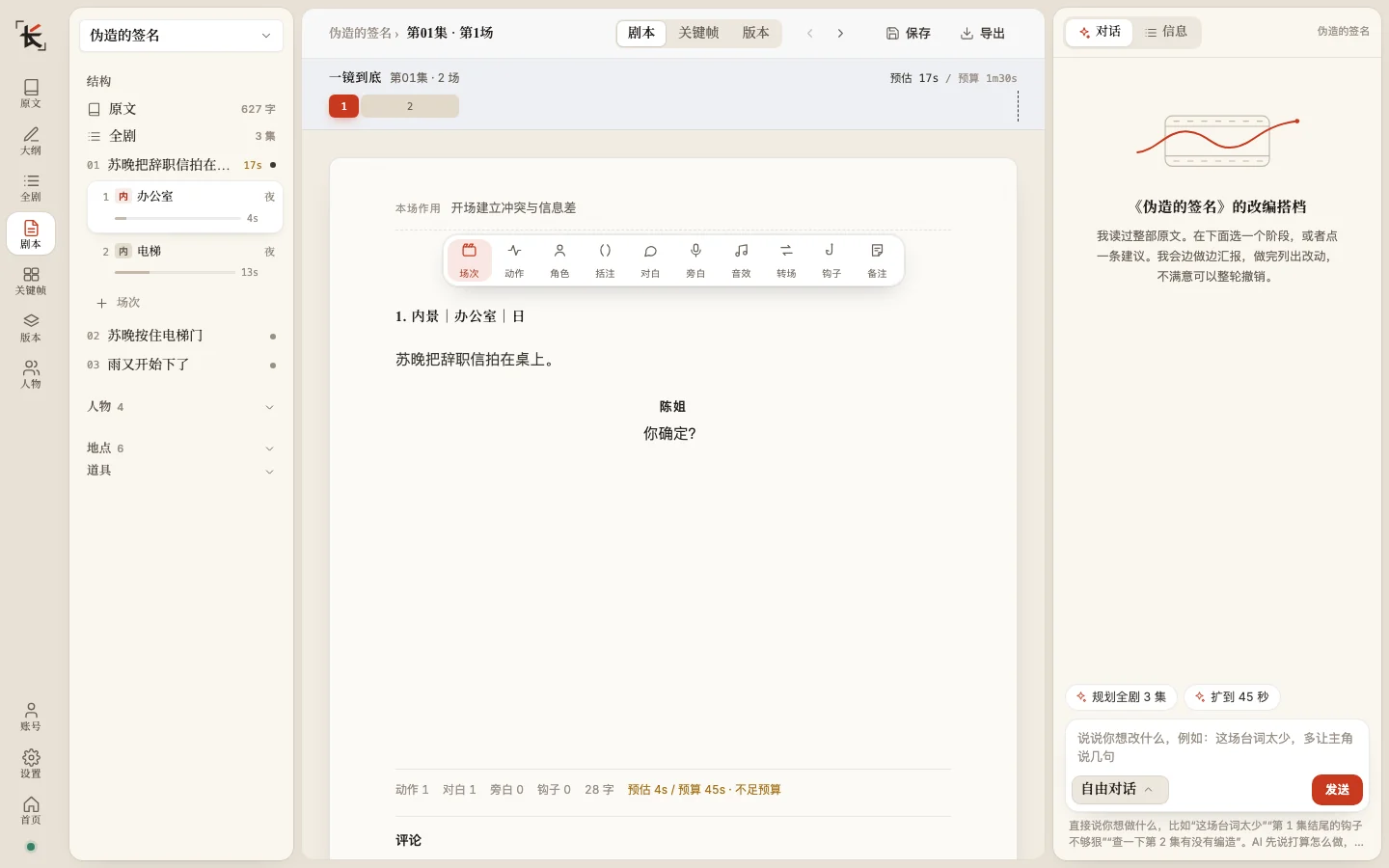
Write in blocks, not lines
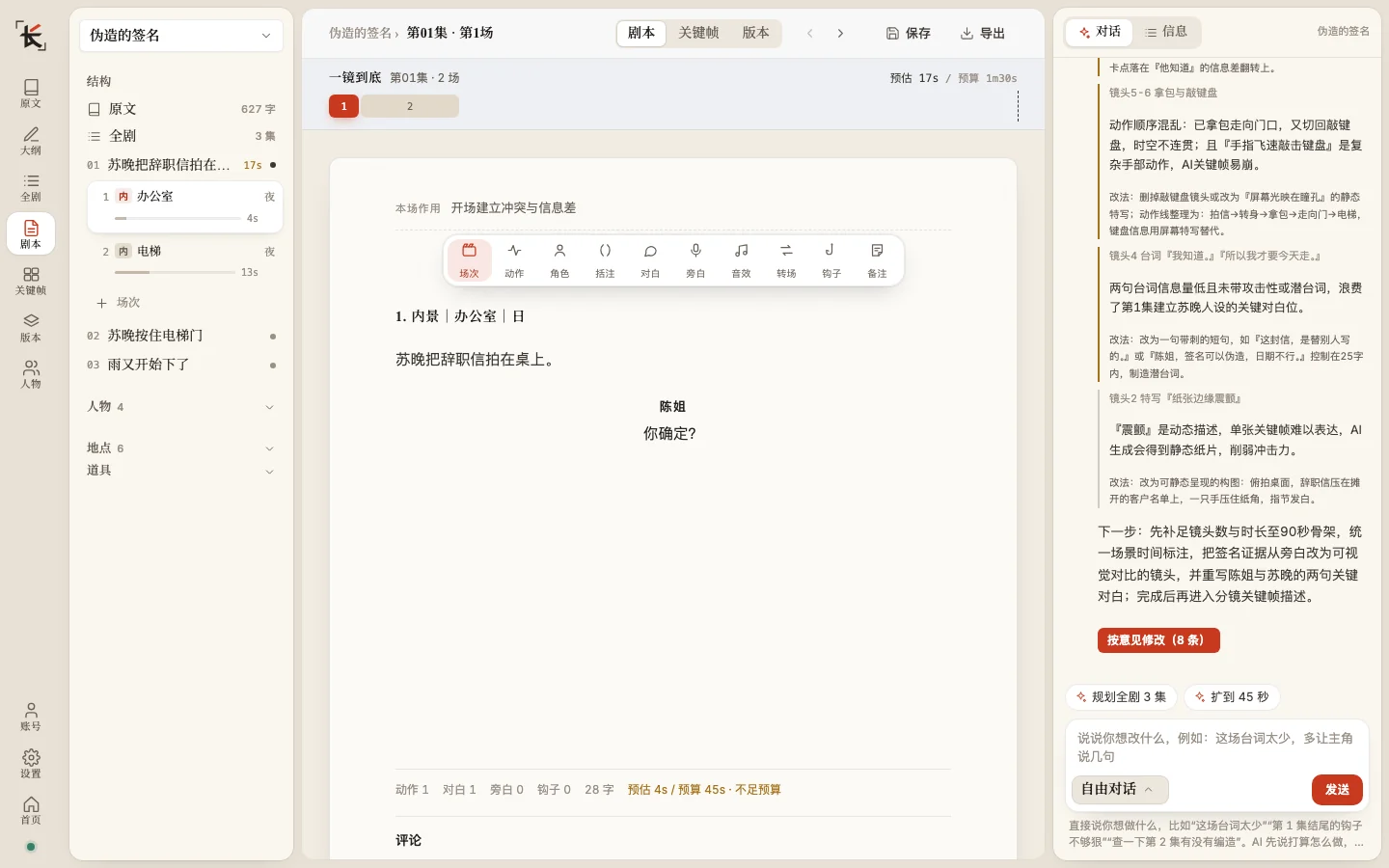
Ten block types: scene, action, character, parenthetical, dialogue, narration, sound, transition, hook and note.
Enter moves you to the block that should come next: dialogue after a character, action after dialogue.
Features
Explore the writing page, shot lists, timing, source checks, and version history.
Edit the outline, cast, script, and shot list in the same project. When the draft or character references change, Oner flags the shots that need a second look.
Ten block types: scene, action, character, parenthetical, dialogue, narration, sound, transition, hook and note.
Enter moves you to the block that should come next: dialogue after a character, action after dialogue.
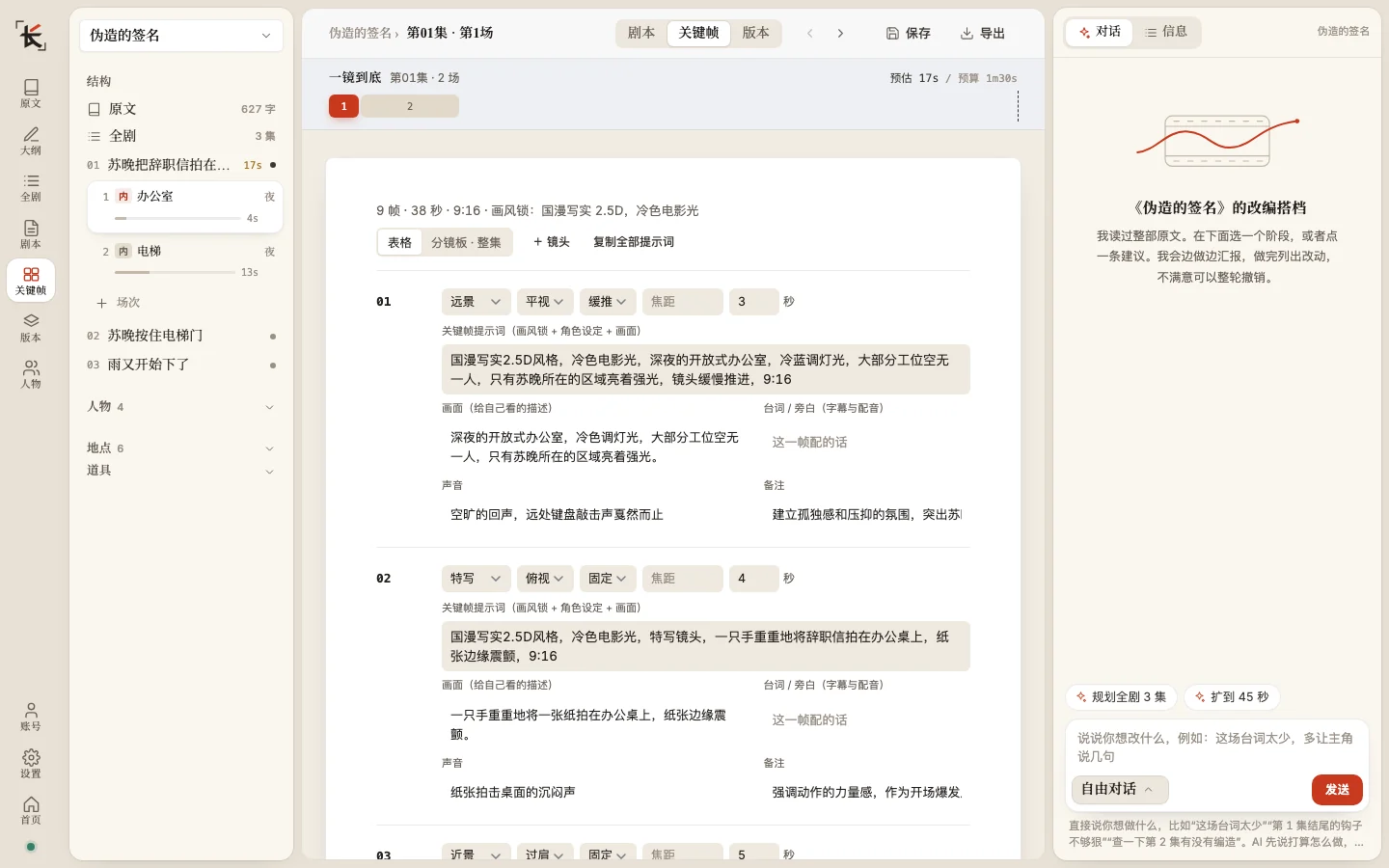
Shot size, angle, camera move, duration, picture, lines, sound and generation prompt, all derived from the script blocks.
Motion comics break down by keyframe, live action by shot–reverse shot. Every field is editable and sortable.
Chapter summaries, then a whole-book analysis: synopsis, genre, tone, core conflict, weighted plot points
and a cast list with aliases already merged.
Every episode gets a core event, a turn and an end hook; every scene is a dramatic unit in one place.
Long novels are split in batches, each batch carrying the summary of the last.
AI drafts, shots, polish and manual saves each record a version.
Line-level diff between any two, one-click restore. A restore is a new version too, so nothing is lost.
Eight directions: dialogue, pacing, emotion, visuals, hooks, consistency, style and length.
Each change lists before, after and why. You decide what stays.
Dialogue is timed by characters, action by description.
Every scene and episode is measured against its target, so over and under show at a glance.
Identity, motive and look anchors enter the cast list during analysis,
names are checked while drafting, and looks are injected into every keyframe prompt.
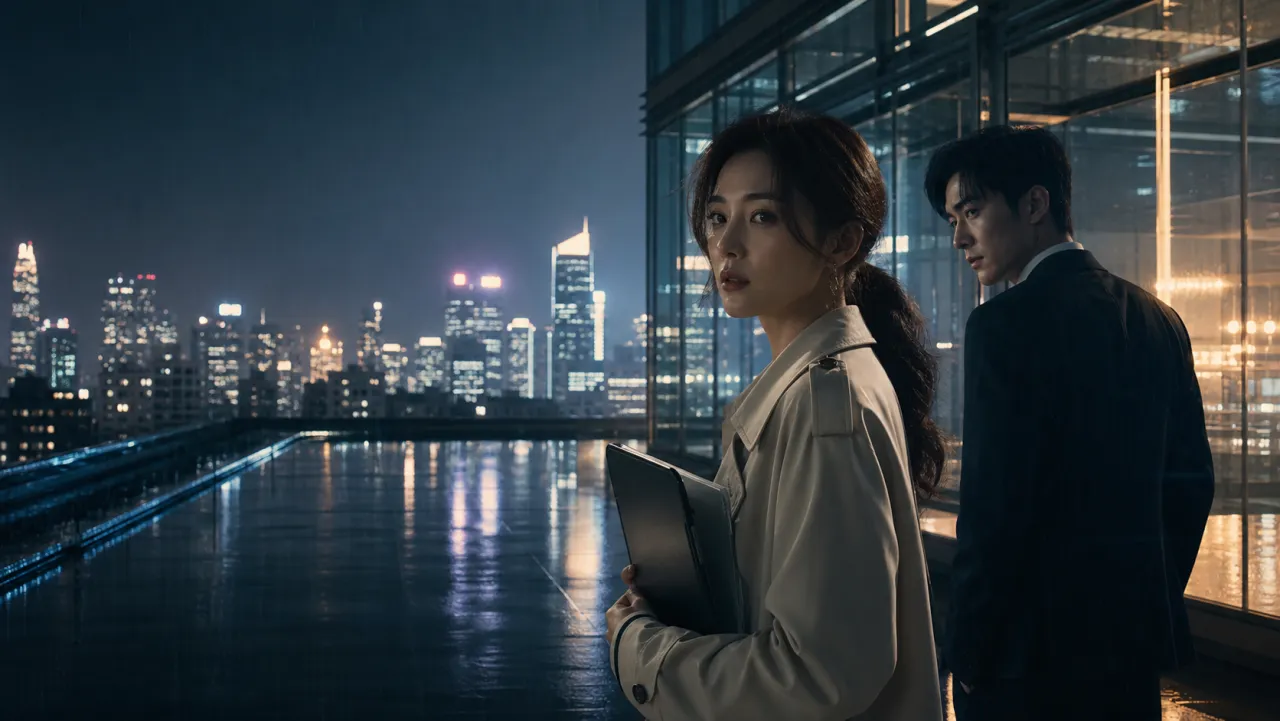
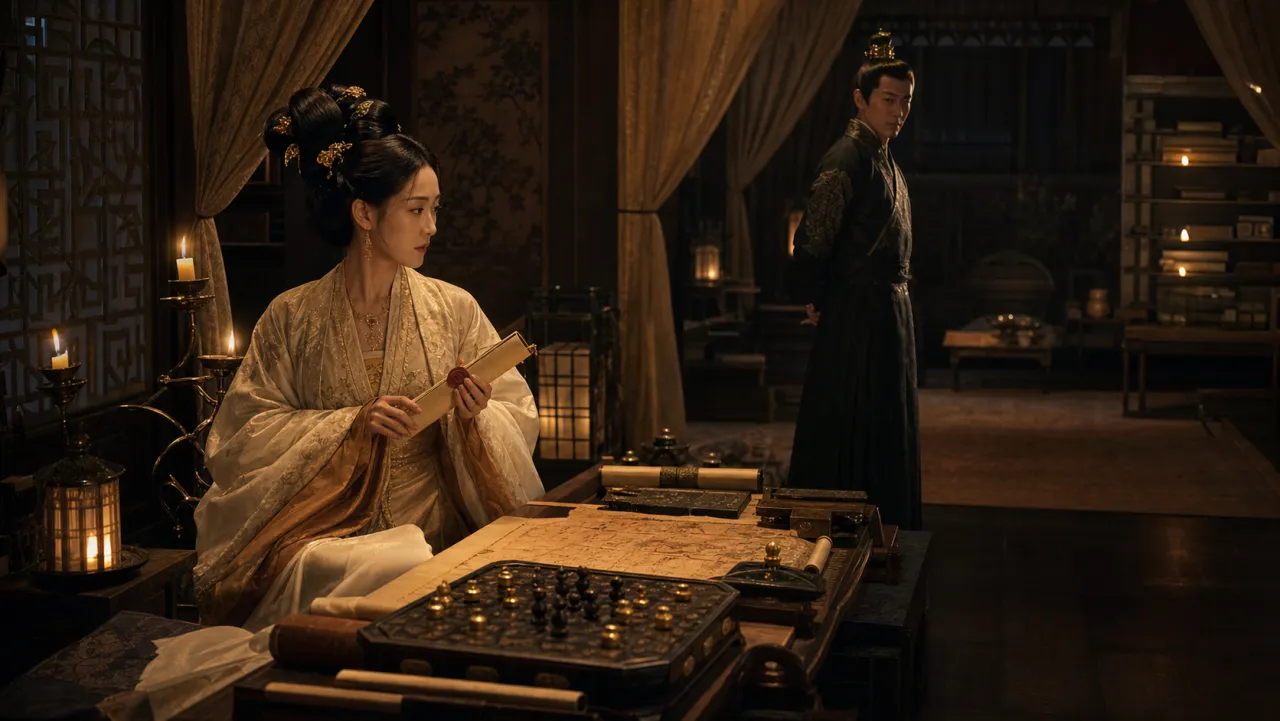
Give actors playable actions, clear locations and props. Hand off the script, breakdown and shot list.
Start with product facts and an audience, choose a concept and write the main film and 30- or 15-second cut-downs.
Oner won't write your story for you. It reads every scene and tells you what it thinks:
structure, motive, pacing and scene-level problems, ranked by severity, each with a fix.
Review a whole episode or a single scene and get six scores plus a list of problems:
pacing, conflict, dialogue, visuals, shootability or generability, continuity.
Compares the script with the novel, block by block, and marks plot, props and lines with no basis in the text. It only flags; you decide.
Platform red lines, content rating and values, scanned scene by scene and graded green, amber, red. The series summary exports to Word.
Checks character, forms of address and timeline across episodes, and rates the strength of every episode's end hook.
Review judges, it doesn't edit. Each problem comes with a fix and a pointer to the polish direction to try next.
The whole series or one episode, as Word, CSV, Markdown or JSON.
Ready for the table read, the set or the render queue.
Episode › scene › action / character / dialogue / narration / hook, as Word or Markdown.
Synopsis, beats, scene list with status and the end hook of every episode.
Episode–scene, location, INT/EXT, day/night, estimated seconds, cast, props.
Line counts by character plus every line, as Word or CSV.
Size, angle, move, duration, picture, lines, sound, prompt.
Look anchors for people, places and props: the basis for makeup and sets.
Per-shot JSON, first frame and motion split, style lock and sheets on top.
The latest check of every scene plus high-severity continuity issues.
Limits matter as much as features. Oner doesn't do these four things, and doesn't plan to.
Refine the text here, then take it to your production tools.
No makeup tests, set images or render queues. Picture quality belongs to the model you choose; Oner hands over clean scripts, shot lists and prompts.
Every step produces one structure or draft, and a person decides what comes next. Twenty-four episodes from one click aren't yours.
Review only judges, polish shows before and after, free conversation proposes steps and waits for you. Every round can be undone and is versioned.
There are no testimonials, customer logos or user counts on this site. The scripts, timings and shot counts here come from original samples and the system's own estimates.
To every AI drama and motion-comic team, and to every short-drama screenwriter
Screenwriters don't dislike generative AI because it writes badly. They dislike it because it always wants to finish the job for them. Twenty-four episodes generated in one click, and not one of them is yours.
You can try one scene first, then use source analysis and a series plan to shape the full story. Keep the script, cast and shots in one project, and review flagged shots after revisions.
AI drama and motion-comic teams need scripts a model can render: one action per shot, people, places and props that look the same in every shot, prompts that open with a style lock. Live-action writers need scripts a crew can shoot: few locations, playable action, episodes that end on a hook. Oner does all three, and stops at the text. The pictures belong to the model you choose; the script stays with you.
The Chinese name 长镜 means "long take". Oner is what film crews call a single unbroken shot: no cuts, one breath, yet every second under your control.
We hope one day you finish the script you've always wanted to make.